
Share






Tendonitis Treatment: Why Rest Alone Is Rarely the Answer
Jun 06, 2026Tendonitis is one of the most patiently mismanaged conditions in modern medicine. Patients are told to rest, ice, take an anti-inflammatory and wait. Some recover. Many do not — and arrive at AEON Centre for Regenerative Wellness six months, two years or a decade later, still carrying the same Achilles, elbow or shoulder pain they were told would settle on its own.
Modern science has moved on. We now understand that most stubborn tendon pain is not inflammation in the classical sense — it is a failure of the tendon to heal. The treatment, therefore, is not rest. It is intelligent stimulation of the body’s own repair mechanism.
What is tendonitis, really?
A tendon is the dense, fibrous tissue that connects muscle to bone. When a tendon is overloaded — through repeated training, poor biomechanics or sudden change in activity — its internal structure begins to break down. The early phase, true tendonitis, involves inflammation. The chronic phase, more accurately called tendinopathy, is a degenerative change in the tendon itself.
This distinction matters because the treatments differ. Anti-inflammatories help in the first weeks. After that, they treat a process that is no longer happening, which is why so many patients feel they are making no progress.
The tendons we treat most often
- Achilles tendinopathy in runners and active adults
- Patellar tendinopathy (jumper’s knee) in tennis, basketball and padel players
- Rotator cuff tendinopathy in swimmers, golfers and desk-bound professionals
- Lateral epicondylitis (tennis elbow) and medial epicondylitis (golfer’s elbow)
- Gluteal tendinopathy and greater trochanteric pain in women over forty
- De Quervain’s tenosynovitis and other repetitive strain conditions
The AEON treatment ladder for tendonitis
Step one — Accurate diagnosis
Tendon pain can mimic, and be mimicked by, joint, nerve and referred pain. A consultation at AEON includes a clinical examination, biomechanical screening and, where indicated, ultrasound imaging in-house. We confirm what we are treating before we treat it.
Step two — Targeted physiotherapy and load management
The most important treatment for any tendinopathy is structured, progressive loading of the tendon. Our specialist physiotherapists design programmes that strengthen the tendon over weeks rather than mask the symptoms. This is supported, where appropriate, by manual therapy, kinesio taping and TECAR therapy to accelerate tissue response.
Step three — Advanced modalities
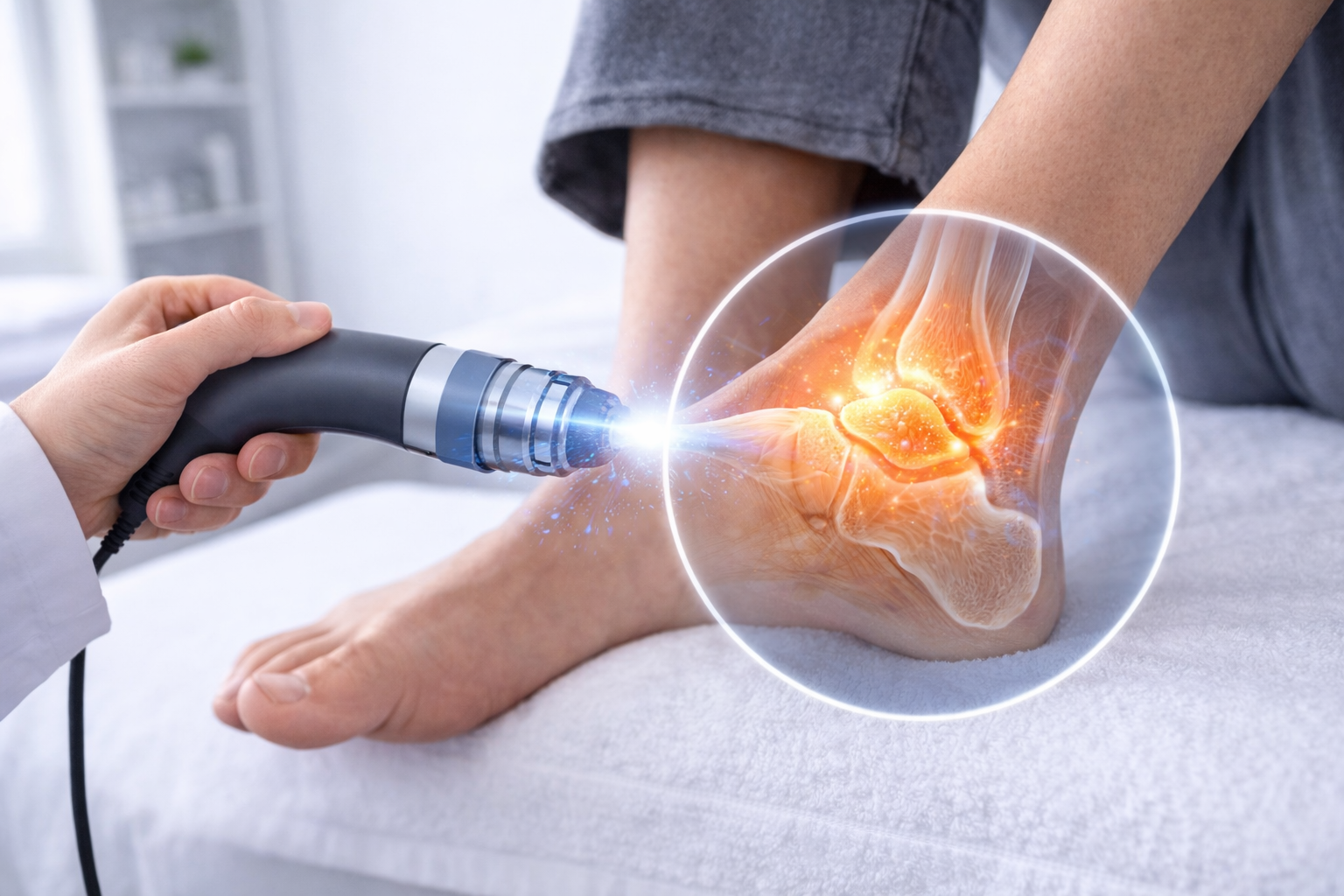
For tendons that have not responded to loading alone, we add focused shockwave therapy, ultrasound therapy and TECAR. These modalities stimulate cellular repair and break the pain-stiffness cycle that has settled into the tissue.
Step four — Regenerative injections
When tendon pain has persisted for months despite excellent conservative care, regenerative injections give the tendon a biological reason to heal. PRP (platelet-rich plasma) uses concentrated growth factors from your own blood, delivered into the tendon under ultrasound guidance. The evidence base for PRP in chronic tendinopathy continues to strengthen, and in our experience, it is one of the most rewarding treatments we offer.
What recovery actually looks like
Tendons heal slowly. This is biology, not a failure of treatment. Most patients begin to feel improvement within four to six weeks of starting a structured programme, with continued gains over three to six months. The patients who recover most fully are the ones who commit to the process, not the ones who chase the quickest fix.
Frequently Asked Questions
How is tendinopathy different from tendonitis?
Tendonitis refers to acute inflammation of a tendon. Tendinopathy describes the chronic, degenerative state most patients are actually in by the time they seek help. The treatments differ, which is why diagnosis matters.
Will rest alone fix my tendon pain?
Rest helps in the first one to two weeks. Beyond that, complete rest weakens the tendon further. Structured loading, not rest, is the foundation of recovery.
Are cortisone injections a good idea?
Cortisone provides short-term relief but does not heal the tendon and, in some cases, weakens it further. AEON uses cortisone selectively, when there is a clinical reason, and prefers regenerative approaches for most patients.
How effective is PRP for tendonitis?
For carefully selected patients with chronic tendinopathy, PRP delivers meaningful and durable improvement. Outcomes are best when combined with structured rehabilitation.
How long until I can return to sport?
Most patients return to modified training within four to eight weeks and to full sport over three to six months, depending on the tendon and severity.
Begin your consultation
If a tendon has been holding you back for longer than it should, AEON offers a more sophisticated answer than rest and anti-inflammatories. Arrange a consultation at Atlantis The Royal with our sports medicine and regenerative team for a precise diagnosis and a plan that actually heals the tendon.
 +971 4 518 5777
 E-Gift Vouchers