
Share






Ligament Injuries in Dubai: Diagnosis, Healing and Why Surgery Isn’t Always the Answer
Jun 06, 2026A ligament injury rarely arrives politely. It is the moment a knee twists on uneven ground, an ankle rolls in a padel match, or a wrist takes the full weight of a fall. The pain is immediate. The uncertainty that follows often lasts longer than the injury itself.
At AEON Centre for Regenerative Wellness in Dubai, we treat ligament injuries with the same principle we apply to every musculoskeletal complaint — diagnose precisely, treat the actual problem, and resort to surgery only when it is genuinely the right answer.
What ligaments do, and why they matter
Ligaments are the strong, fibrous bands that connect bone to bone. They stabilise joints, guide movement and protect the structures around them. When a ligament is stretched, partially torn or fully torn, the joint loses its precise control, and a cascade of secondary problems can follow if the injury is not treated correctly — instability, cartilage damage, early osteoarthritis.
Common ligament injuries we treat
- ACL, PCL, MCL and LCL injuries of the knee
- Lateral and medial ankle ligament sprains
- AC joint and shoulder ligament injuries
- Wrist and thumb ligament injuries, including skier’s thumb
- Spinal ligament strains and instability
- Chronic ligament laxity and recurrent sprains
Grading a ligament injury
Not all ligament injuries are equal. Treatment is shaped by the grade of injury, identified through clinical examination and, where needed, ultrasound or MRI:
- Grade 1 — Mild stretch with microscopic tearing. Local tenderness, minimal instability.
- Grade 2 — Partial tear. More significant pain, swelling and some loss of joint stability.
- Grade 3 — Complete tear. Marked instability, often requiring surgical or regenerative intervention.
The AEON approach to ligament recovery
Acute care done well
The first seventy-two hours after a ligament injury shape the next six months. Our team manages acute injuries with appropriate immobilisation where needed, controlled mobilisation where possible, manual therapy, kinesio taping and graded loading. The goal is to protect the ligament without allowing the joint to stiffen.
Regenerative options for stubborn cases
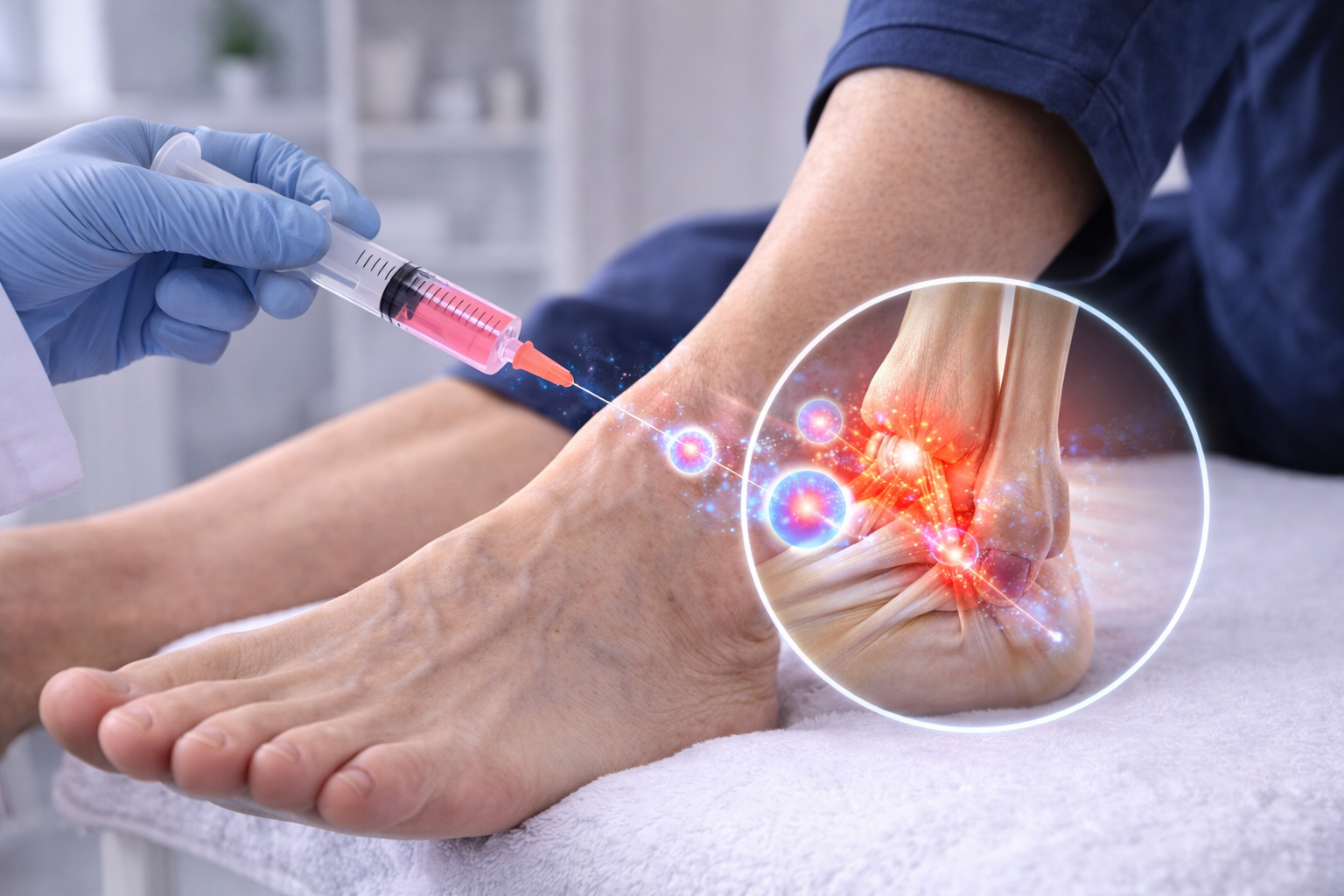
Ligaments have a poor blood supply, which is why some injuries simply do not heal as expected. For these cases, PRP and, in selected patients, stem cell therapy can stimulate ligament repair and restore joint stability. These options are particularly valuable for partial tears and chronic ligament laxity that has resisted standard care.
When surgery is the right choice
There are injuries — most commonly complete ACL ruptures and certain ankle and shoulder dislocations — where surgical reconstruction delivers the best long-term outcome. AEON works with a trusted network of orthopaedic surgeons across Dubai for these cases, then continues your rehabilitation with us. The result is one continuous plan, not a series of disconnected handovers.
Returning to the activities that matter
A ligament that has healed without proper rehabilitation is a ligament that is likely to be injured again. Every recovery plan at AEON includes biomechanical retraining, sport-specific conditioning and, where helpful, sports taping protocols to support the joint as you return to full activity. We do not declare a patient recovered until they are stable, strong and confident.
Frequently Asked Questions
How can I tell if I have torn a ligament?
Sudden pain, audible pop, immediate swelling and a feeling of joint instability are classic signs. Definitive diagnosis requires clinical examination and, in many cases, ultrasound or MRI.
Do all ligament tears need surgery?
No. Many partial tears and selected complete tears heal well with structured rehabilitation, regenerative support and time. Surgery is reserved for injuries where it offers a clearly better long-term outcome.
How long does a ligament injury take to heal?
Mild sprains often recover in two to four weeks. More significant injuries can take three to six months. Chronic ligament problems may require longer, layered treatment.
Can PRP help a ligament heal?
Yes, particularly for partial tears and chronic laxity. PRP delivers concentrated growth factors directly to the injured ligament under ultrasound guidance.
What does ligament recovery cost?
Costs depend on imaging, the modalities used and whether regenerative injections are required. After your assessment, you will receive a transparent, written plan.
Begin your consultation
If a ligament injury is keeping you from the sport, work or life you want, AEON offers a precise, considered path back. Arrange a consultation at Atlantis The Royal with our sports and regenerative medicine team for a clear diagnosis and a plan built around your goals.
 +971 4 518 5777
 E-Gift Vouchers